BACTERIAL VOC REMOVAL SYSTEM

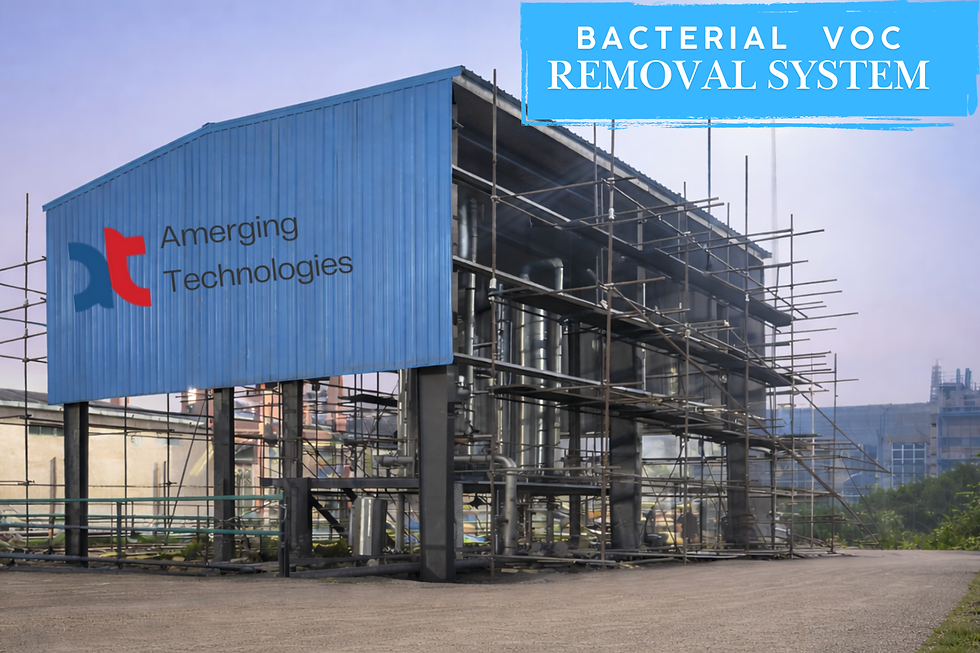
Introduction to Bacterial VOC Removal System
An Overview of the Project
Volatile Organic Compounds (VOCs) are one of the most critical environmental challenges in refinery operations. Emissions from Effluent Treatment Plants (ETPs), storage tanks, and process vents are strictly regulated due to their impact on air quality, health, and environmental compliance.
Traditionally, refineries rely on activated carbon or charcoal-based adsorption systems to capture VOCs. While effective, these systems primarily transfer pollutants from one medium to another and require periodic replacement, resulting in recurring operational costs and secondary waste generation.
A Bacterial VOC Removal System introduces a sustainable alternative, converting pollutants into harmless byproducts through biological degradation.
Instead of merely capturing VOCs, this system uses specialized microbial cultures that metabolize volatile organic compounds and break them down into carbon dioxide (CO₂) and water (H₂O). The process is self-regenerating, environmentally friendly, and aligned with long-term sustainability goals.
Project Overview
The project involved the installation of an industry-scale pilot Bacterial VOC Removal System at a refinery’s ETP section. The objective was to:
Biodegrade collected VOC emissions
Evaluate system performance under real refinery operating conditions
Collect operational data for further optimization
Demonstrate the feasibility of biological VOC treatment at an industrial scale
The system was designed in a modular, skid-mounted configuration to ensure ease of integration within limited refinery space and to meet strict safety standards.
Challenges of Executing a Turnkey Project in a Refinery
Executing a turnkey project in a refinery environment is significantly more demanding than conventional industrial installations. Refineries operate under highly controlled, hazardous, and time-sensitive conditions.
Hazardous Area Compliance
Strict Safety Protocols
Limited Installation Windows
Multi-Disciplinary Coordination
Performance Validation Requirements
How Amerging Successfully Designed, Installed & Commissioned the Turnkey Project
Amerging Technologies approached this project as a complete turnkey responsibility — from design engineering to commissioning and performance validation.
Engineering & System Design
Our team conducted detailed process studies to understand refinery VOC load characteristics and site constraints. The system was engineered with:
Modular skid-mounted architecture
Integration-ready piping and instrumentation
Hazardous area compliant components
Automation-driven monitoring and control
The design ensured operational flexibility and future scalability.
Manufacturing & Pre-Commissioning
To reduce on-site risk:
Major assemblies were pre-fabricated and tested at our facility
Instrumentation loops were verified before dispatch
Documentation and operating protocols were prepared in advance
This approach minimized installation uncertainties inside the refinery.
Installation in Refinery Environment
Despite being one of our first refinery-based biological emission projects, the Amerging team successfully:
Coordinated closely with refinery safety and operations teams
Completed mechanical erection within allocated windows
Ensured compliance with all hazardous area norms
Integrated the system seamlessly with existing VOC collection lines
Our structured execution plan allowed smooth installation without operational disruption.
Commissioning & Performance Demonstration
During commissioning:
Microbial culture acclimatization was carefully managed
System parameters were optimized step-by-step
Live monitoring ensured process stability
Performance trials were conducted under different load conditions
The system achieved stable operation and demonstrated effective VOC degradation, validating biological treatment as a viable alternative in refinery environments.
The successful implementation of the Bacterial VOC Removal System marks a significant milestone in integrating sustainable biotechnology into heavy industrial sectors.
This project demonstrates that:
Biological systems can operate reliably in refinery environments
Sustainable solutions can meet strict industrial compliance norms
Turnkey execution in hazardous zones requires both engineering depth and disciplined execution
Amerging Technologies continues to expand the boundaries of bioprocess engineering — bringing innovation, sustainability, and industrial reliability together.

Comments